

Why Hose Length Has Limits
Insulation vacuums, regardless of manufacturer, are engineered to perform best within a 100 to 150 foot range. Push much past that, and you start losing the airflow and suction that make the job efficient. The trouble is, plenty of real-world jobsites don’t give you that kind of luxury.
Real-World Situations That Demand More Reach
- Gas-powered vacuums have to stay outside. Running a gas vacuum indoors risks carbon monoxide poisoning, so it has to remain outside the building at all times. We work with customers who vacuum debris out of furnaces located deep inside large commercial buildings — and even though electric vacuums are an option, many still choose gas power and need it to reach 300 feet from the outside of the building to the furnace.
- Stilt homes along the Gulf Coast. Local building code along the Gulf often requires homes to sit on stilts at least 10 feet high. That elevation alone can eat up 100 feet of hose just to reach the attic access — before you’ve even started the job. Ganging two vacuums in-line makes that reach realistic.
- Ultra-long distances. One of our customers needed 700 feet of hose to reach a navy ship. He combined a CoolVac40 with a CoolVac23 and was able to reach and have great suction.
- Want to go faster? A two-man team can vacuum much faster with vacuums that are daisy-chained. It is very important to always have a person on the ground vacuuming. When you have only two people, having two vacuums running in parallel is not efficient or safe. Combining two vacuums in a daisy-chain fashion allows this smaller team to combine the power of two vacuums.
- Customers who don’t want equipment on the lawn. Some homeowners want every piece of equipment staged from the street or driveway — no setup on the grass, period. That preference alone can push you well past a single vacuum’s effective range.
The Solution: Gang Your Vacuums In-Line
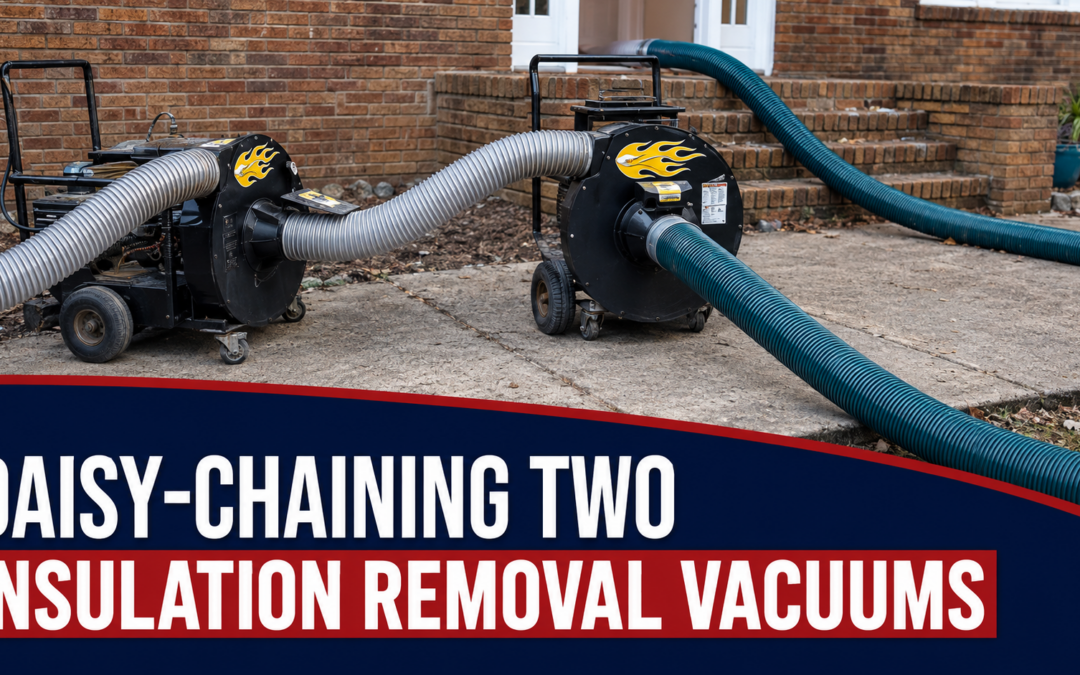
You can connect two vacuums in-line to multiply your effective reach — and they don’t need to match. You can gang together vacuums of the same horsepower, or pair different horsepower units, and either setup works.
Technical Data: Combined CoolVac23 Performance
To show what daisy-chaining actually does to performance, we ganged two CoolVac23 units together and measured the results against a single unit running alone.
Ganging two CoolVac23s in-line nearly doubles the water column measurement — from 27″ to 48″ — while also increasing airflow, giving you both the suction depth and the volume needed to push material through a much longer hose run.
Frequently Asked Questions


