

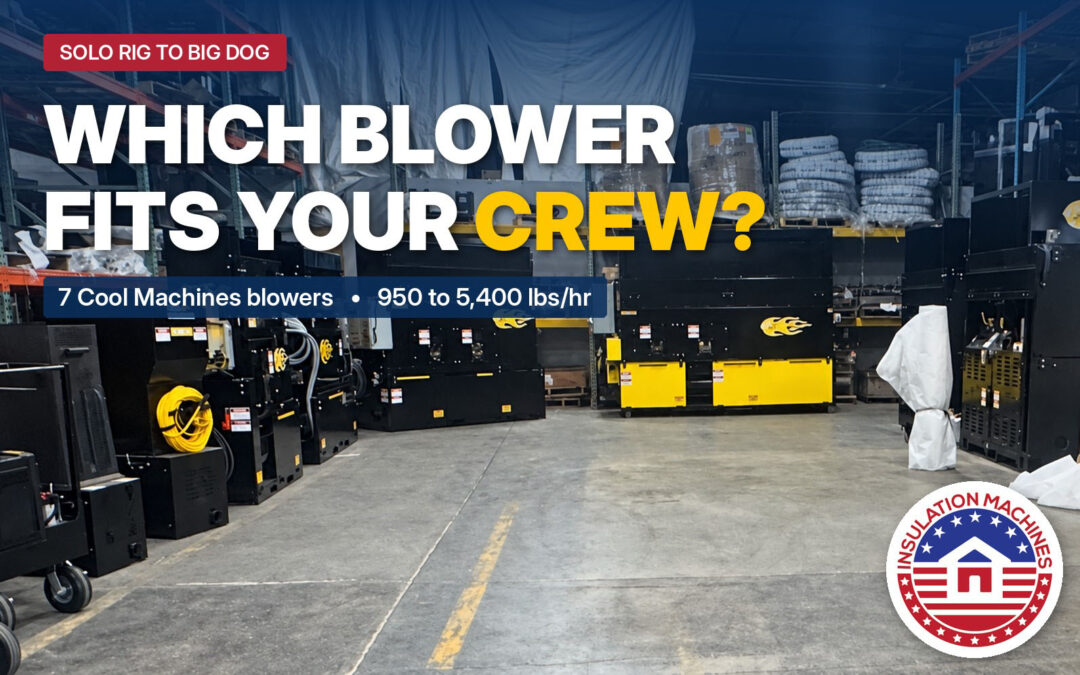
The Lineup at a Glance
Every Cool Machines blower is built around the same idea: dual “scalping” augers that break up compressed bales, plug-and-play electrical modules that are quick to troubleshoot, and parts that are simple to replace in the field. What changes as you move up the line is hopper size, airlock size, blower power, and what it takes to feed the machine electricity.
| Model | Cellulose (lbs/hr) | Fiberglass (lbs/hr) | Power | Best fit |
|---|---|---|---|---|
| CM700 | 950 | 400 | 120V, 15A | Solo operator, pest control add-on |
| CM1500 / HP | 2,200 / 3,000 | 900 / 1,200 | 120V, 15/15–15/20A | Start-up contractor, backup rig |
| CM2400 | 3,000–4,500 | 1,200–1,800 | 120V (2-blower) or 240V, 30A | First truck or trailer system |
| CM3000XL | 4,500–5,400 | 1,800–2,400 | 240V, 35A | Growing production crew |
| CM3500XL | 4,500–5,400 | 4,500–5,400 | 240V 30–50A, or 3-phase | Self-contained wall spray truck |
| CM4500XL | 4,500–5,400 | 1,800–2,400 | 240V 30A or 480V 3-phase | High-volume and commercial crews |
| CM3X | 5,000 | 2,300 | Gas, diesel, battery, PTO, generator or shore | Production crews who want power flexibility |
Ranges reflect airlock and blower options. Manufacturer ratings; real-world output varies with material, hose length, and elevation.
CM700: The DIY Machine
The CM700 is the smallest blower in the family at about 180 lbs, and it plugs into a standard 120-volt, 15-amp outlet on the Standard model (the Deluxe uses a double 15-amp input for its bigger 13-amp blower). It handles cellulose, fiberglass and rockwool for attics, dense packing, and wall spray, just at a more modest pace — rated 950 lbs/hr of cellulose.
Fits your crew if: you are a solo operator, a handyman adding insulation to your services, or a pest control company running attic restoration as an add-on. It fits in a van or the bed of a pickup with no generator.
CM1500 Series: The Start-Up Contractor’s Workhorse
The CM1500 is the machine a lot of insulation companies are built on. It weighs 330–360 lbs, has a 13.5 ft³ hopper, and still runs on 120-volt power. The standard machine rates 2,200 lbs/hr of cellulose; the CM1500HP stretches the base to fit an 18-inch airlock and jumps to 3,000 lbs/hr of cellulose and 1,200 of fiberglass with the same feel as the standard machine.
Fits your crew if: you are a one- or two-person contractor doing attic jobs every day, or you already run a truck rig and want a portable backup that can go where the truck cannot.
CM2400: Your First Truck or Trailer Rig
The CM2400 is compact — 62 inches long and under 800 lbs — which is exactly why it is the usual first step onto a truck or trailer. You can load this machine without cutting fiberglass bags in half. It is also the most scalable machine in the lineup. With the standard 12-inch airlock it rates 3,000 lbs/hr of cellulose; the 16-inch airlock bumps that to 3,600, and the 20-inch airlock takes it to 4,500.
Power is flexible too: the 2-blower box runs on a 120-volt double input, while the 4-blower box and PD blower run on a 240-volt, 30-amp single input.
Fits your crew if: you have outgrown hauling a portable machine in and out of every house and want a trailer or truck setup without a giant generator.
CM3000XL: The “Just Right” Production Machine
Cool Machines describes the CM3000XL as the middle ground between the CM2400 and the full-size CM3500XL, and that is a fair way to think about it. It rates 4,500 lbs/hr of cellulose with the 20-inch airlock and 5,400 lbs/hr with the optional 24-inch airlock and turbo-shredder. The 27 ft³ hopper grows to 46–52 ft³ with an extension, so the hose crew is not waiting on reloads.
The standout feature for fleet owners is the reversible hopper with a front pull-out airlock: mount it at the rear driver side, passenger side, or front of the box, whichever fits your truck or trailer layout. It runs on a single 240-volt, 35-amp input and pairs well with an optional 12 kW generator.
Fits your crew if: you run a dedicated two- or three-person crew doing production attics and dense pack. The 24 inch airlock outperforms the CM2400 and doesn’t take up much more room.
CM3500XL: The Self-Contained Spray System
The CM3500XL is designed around a complete truck system: dual metering hoppers, self-contained hose reels, heated water tanks, and a generator, so a crew can roll up and be spraying or blowing in minutes. The dry hopper holds 40 ft³ (71 ft³ with an extension), and blower options run from a 4-blower box up through 5, 7.5, 10 and 15 hp PD blowers, with 12-inch by 20- or 24-inch airlocks.
Because its power draw is modest for its size, it can run off 240-volt, 50-amp job-site grid power to save generator fuel. For wall spray, there are dedicated CM3500VH (Vacuum Hood) and CM3500VP (integrated Vac-Pack) configurations.
Fits your crew if: wall spray cellulose in new construction is a big part of your business and you want one truck that carries everything. Production depends heavily on the blower and airlock you spec, so talk with us about the configuration that matches your jobs.
CM4500XL: The “Big Dog”
The CM4500XL is the flagship. Its large hopper holds about 24 bags of cellulose, so the operator can leave the truck for long stretches to help inside the house. It rates 4,500 lbs/hr of cellulose standard, and with the optional 12×24-inch airlock and 10 hp PD blower it reaches 5,400 lbs/hr of cellulose and 5,000 lbs/hr of rockwool.
The CM4500XL-VP adds a 10 hp PD Vac-Pack recovery system, a separate recycle hopper, and dual slide gates that meter dry and recycled fiber together, so the spray nozzle can keep running. It is rated for about 40 bags per hour of wall spray cellulose. Plan your power accordingly: the 5 hp model runs on 240-volt, 30-amp single phase, while the 10 hp model needs 480-volt, 20-amp three-phase.
Fits your crew if: you run large residential, multifamily, or commercial jobs where every hour of nozzle time matters, and you have the truck and generator to support it. If you are a one-man crew, this machine allows you to load up to 25 bags of cellulose so you can blow attics or wall spray alone.
CM3X: The Newest High-Production System
The CM3X is the newest machine in the family, built from the ground up as a front-mount system. A 24-inch airlock comes standard, and it rates 5,000 lbs/hr of cellulose (about 227 bags of 22-lb cellulose per hour), 2,300 lbs/hr of fiberglass, and 2,600 lbs/hr of rockwool at 100 feet of hose and a 12-foot rise. It handles cellulose, fiberglass, mineral wool, and wood fiber.
What sets it apart is the power plant choice. Most big blowers lock you into one power source; the CM3X can be built with a Honda GX690 22 hp gas engine, a 25 hp Kubota diesel, a lithium iron phosphate battery pack (an industry first, for quiet, zero-emission work), or a PTO off your truck. It can also run on a Winco 18000 generator or building power at 240-volt 60-amp single phase or 480-volt 30-amp three phase.
Inside, dual hopper agitators and a scalping auger keep material from bridging, and the new Hyper-Shredder conditions fiber more thoroughly for better coverage per bag and fewer hose plugs. The 110 ft³ hopper lets one crew member stage material while the machine keeps running.
Fits your crew if: you run high-volume residential or commercial jobs and want to match the power source to your truck and your neighborhoods — diesel for long commercial days, battery where noise rules are strict.
How to Pick: Four Questions for Your Crew
1. How many people are on the hose and the hopper? One person who loads and blows needs a light, portable machine (CM700 or CM1500). Once someone is dedicated to feeding the hopper, a truck machine starts paying for itself.
2. What power will you have on site? If you plug into the customer’s house, stay with the CM700, CM1500, or CM2400 with a 2-blower box. Everything above that assumes a generator or 240-volt service — except the CM3X, which can carry its own engine, battery, or PTO drive.
3. How much of your work is wall spray? Occasional spray work can be covered by the CM700 Recycler or CM1500VHS. If spray is the core of your business, look at the CM3500XL or CM4500XL-VP.
4. What is your bottleneck today? If the crew is waiting on material, you need more airlock or blower. If you are reloading constantly, you need more hopper. If neither, you may not need a bigger machine yet — and that is good news for your cash flow.
Not sure which machine fits?
Call us at 877-909-USMADE or email barry@insulationmachines.net. Tell us your crew size, power setup, and the jobs you run, and we will help you spec the right blower, airlock, and hose package.
Frequently Asked Questions
Which Cool Machines blower is best for a one-person crew?
For a solo operator or a pest control company adding attic insulation, the CM700 is the easiest fit: about 180 lbs, runs on a standard 120-volt 15-amp circuit, and rates 950 lbs/hr of cellulose. Also, the largest CM4500XL allows you to fill its large hopper. If you are a one- or two-person contractor doing full attic jobs every day, step up to the CM1500, which rates 2,200 lbs/hr of cellulose (3,000 lbs/hr in the CM1500HP) while still running on 120-volt power.
Can I run a Cool Machines blower on regular household power?
Yes. The CM700 and the entire CM1500 series run on 120-volt power, and the CM2400 with the 2-blower box runs on a 15/30-amp double input at 120 volts. The CM2400 with a 4-blower box or PD blower, the CM3000XL, CM3500XL and CM4500XL all need 240-volt power, and the 10 hp CM4500XL needs 480-volt 3-phase, so those are typically paired with a generator on a truck or trailer. The CM3X is the exception at the top of the line: it can run on its own gas or diesel engine, a lithium battery pack, or your truck’s PTO instead of house power.
What is the difference between a blower box and a PD blower?
A blower box uses multiple 13-amp electric vacuum-motor blowers (about 140 cfm each) ganged together. A positive displacement (PD) blower is a single belt- or motor-driven unit rated by horsepower, from 5 hp up to 15 hp across the lineup. PD blowers deliver more pressure for long hose runs, dense packing and wall spray, while blower boxes are lighter and less expensive.
Does airlock size really change production?
Yes, significantly. On the CM2400, moving from the standard 12-inch airlock to the 20-inch airlock raises the cellulose rating from 3,000 to 4,500 lbs/hr. On the CM3000XL, the optional 24-inch airlock raises cellulose from 4,500 to 5,400 lbs/hr. A longer airlock moves more material per rotation, so it is often the cheapest way to add production to a machine you already like.
Which Cool Machines blowers can handle wall spray cellulose?
The CM700 Recycler recovers scrubbed material and doubles as a stand-alone blower. The CM1500VHS pairs with an insulation vacuum of 16 hp or more to recover material into the hopper. The CM3500XL is built as a self-contained spray system with hose reels, heated water tanks and a generator, and offers VH and integrated Vac-Pack versions. The CM4500XL-VP adds a 10 hp PD Vac-Pack recovery system and is rated for about 40 bags per hour of wall spray cellulose.
How are Cool Machines production rates measured?
Cool Machines publishes rates for the CM700 and CM1500 measured with 100 feet of hose at a 12-foot rise. Real-world output depends on the brand and density of material, hose length and diameter, elevation, and how well the material is conditioned, so treat ratings as a ceiling for comparison rather than a guaranteed number on every job.
When should I move from a portable blower to a truck-mounted machine?
Move up when the machine, not the crew, is the bottleneck: the hose crew is waiting on material, you are reloading the hopper constantly, or you are turning down dense-pack and commercial jobs. The CM2400 is the usual first truck or trailer machine because it is compact and can still start on a 2-blower box, and the CM3000XL is the next step for crews that need 4,500 lbs/hr or more without the full size of the CM3500XL.
Can the CM3000XL be mounted on the passenger side of a truck or trailer?
Yes. The CM3000XL has a reversible hopper and a front pull-out airlock, so it can be mounted at the rear driver side, the passenger side, or the front of a truck box or trailer.
Which Cool Machines blower can run without a generator or shore power?
The CM3X. Instead of locking you into one power source, it can be built with a Honda GX690 22 hp gas engine, a 25 hp Kubota diesel, a lithium iron phosphate (LiFePO4) battery power plant, or a power take-off (PTO) from your truck. It can also run on a Winco 18000 generator or building power (240-volt 60-amp single phase or 480-volt 30-amp three phase). The battery option is an industry first and gives quiet, zero-emission operation for neighborhoods with noise limits.


