

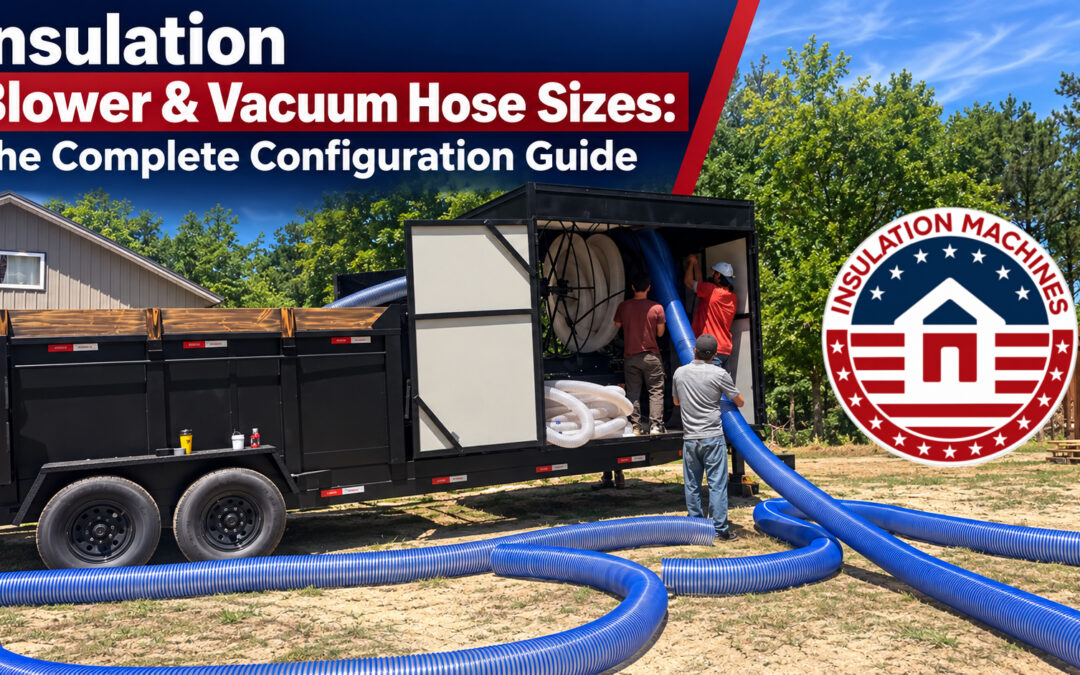
Hose Sizes and Configurations for Insulation Blowing Machines and Vacuums
Blowing Machines: Diameter Comes First
The output port on your machine sets the ceiling for hose diameter. If your machine has a 3” output, you can run 3” hose — or step down to a smaller diameter — but you should not step up to a larger diameter. The one exception is a short section, just a couple of feet, at the machine when an Internal Wetting System is attached.
Reducing hose diameter downstream is fine and common. Increasing it beyond the machine’s output diameter is not, and doing so changes how the machine performs in ways that aren’t obvious until you’re on the job.
What Determines the Best Length of Hose?
Two factors drive how far you can run hose from a blowing machine: airflow strength and material weight.
Airflow Strength
A machine with a single blower motor is generally good for up to 150 feet of hose. Add more blowers, and you extend that distance. PD (positive displacement) blowers work differently — they’re pumps, not blowers — and can reliably push material 400 to 600 feet.
Material Weight
Cellulose is heavier than fiberglass, so machines running cellulose need more blower strength to cover the same distance. That weight increases further when water is introduced, whether through a wall spray application or an Internal Wetting System. When you’re wetting material, plan on either adding blower strength or shortening your hose run.
The Hose-Extension Myth
We’ve seen customers try to boost output by attaching a short section of larger hose — for example, 25 feet of 4” hose at the end of 150 feet of 3” hose — and report that it “increased productivity.” It didn’t. What actually happens is that the sudden jump in diameter lets the material expand and spread out, which looks and feels like more volume. In reality, it just separates the material and blows it out more wildly and less accurately than a properly sized, consistent-diameter hose run would.
Insulation Vacuums: Input and Output Are Different Problems
Much of the same logic that applies to blowers applies to vacuums, but vacuums have two hose connections to think about — input and output — and each behaves differently. Vacuums generate a lot of CFM, and water column (suction strength) matters just as much as airflow.
Input Hose
Use as much vacuum hose as the job requires, but no more. The shorter your input hose run, the stronger and faster your extraction will be. Extra hose on the input side is pure suction loss with no upside.
Vacuum hose is available in two weights: heavy duty and lighter weight. Both are durable options. Use the heavy duty to go from the machine to the attic. Then use the lighter weight in the attic. Fatigue happens quickly if you use the heavier duty hose in the attic.
Output Hose
Keep output hose to roughly 10–15 feet. Vacuums are built to pull material in, not push it out, so the output side isn’t designed to handle long hose runs. Adding more hose to the output will degrade suction on the input side.
The Bottom Line
Matching hose diameter to your machine’s output, keeping runs within your blower or vacuum’s real capability, and accounting for material weight (especially wetted cellulose) will get you more consistent, productive results than any workaround. When in doubt, size down rather than up, and keep hose runs as short as the job allows.
Frequently Asked Questions: Hose Sizes and Configurations
What determines the maximum hose diameter I can use with my blowing machine?
The output diameter of the machine sets the maximum. If your machine has a 3” output, 3” is the largest hose you should run. You can reduce to a smaller diameter, but you shouldn’t increase beyond the machine’s output size.
Is there any exception to the “don’t increase hose diameter” rule?
Yes — a short section, just a couple of feet, of larger hose is acceptable at the machine when you’re running an Internal Wetting System. Beyond that, stepping up in diameter isn’t recommended.
How far can I run hose from a blowing machine?
It depends on your blower setup. A single-blower-motor machine typically handles up to 150 feet of hose. Adding more blowers extends that range. PD (positive displacement) blowers function as pumps and can reliably push material 400–600 feet.
Does the type of insulation material affect hose length?
Yes. Cellulose is heavier than fiberglass and requires more blower strength to travel the same distance. Adding water — through a wall spray or Internal Wetting System — increases material weight further, so plan on extra blower strength or a shorter hose run.
Will adding a larger-diameter hose section at the end of my hose run increase productivity?
No. Attaching a larger hose section at the end — for example, 25 feet of 4” hose after 150 feet of 3” hose — only lets the material expand, which can look like more output. In practice, it separates the material and blows it out more wildly, not more productively.
How much hose should I use on a vacuum’s input side?
Use as much as the job requires, but no more. Shorter input hose runs mean stronger, faster extraction, since every extra foot reduces suction.
How much hose should I use on a vacuum’s output side?
Keep it to about 10–15 feet. Vacuums are designed to pull material in, not push it out, so longer output hose runs will degrade suction on the input side.


