

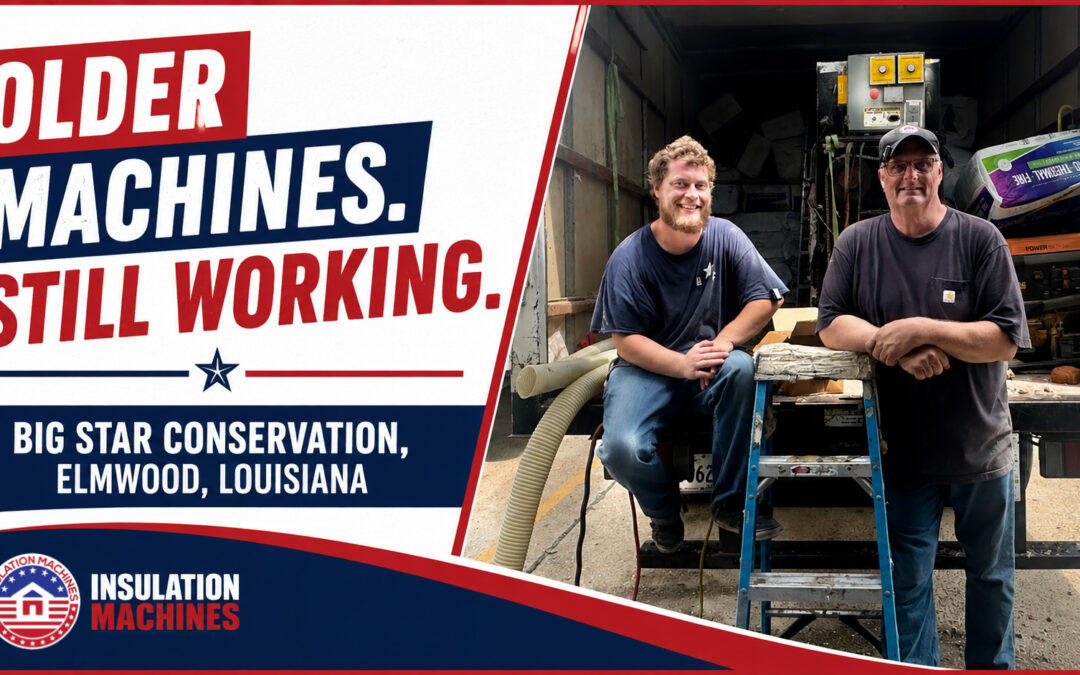
Some insulation blowers just refuse to quit. In Elmwood, Louisiana, a contractor’s CM1500 and CM2400 are still pulling their weight years after purchase — proof that with the right maintenance routine, these machines can outlast their warranty by a long shot. Here’s what’s kept them running.
When an older insulation blower starts making unusual noises, stops feeding material properly, or simply isn’t performing the way it should, it can be easy to assume the worst. Sometimes, however, the problem is much simpler than it sounds.
We recently traveled to Elmwood, Louisiana, to work with Big Star Conservation on two older insulation blowers: a CM2400 and a CM1500 by Cool Machines. Before our visit, the symptoms Big Star Conservation described over the phone sounded like they could potentially involve some of the machines’ major components. We came prepared with the parts we might need, including replacement blowers and agitator components.
Once Barry began working through the machines, however, we found some very good news: neither insulation blower needed its major components replaced.
An Older CM2400 That Still Had Plenty of Life
The CM2400 was running rough, and there were concerns that the machine could have significant mechanical problems.
As we worked through the insulation blower, one of the biggest issues became apparent: the chains were extremely stretched. When we compared the old chain to a new chain, individual links had stretched approximately 1/8 inch longer than normal. Across the length of the chain, that additional play adds up. The stretched chain was jumping the sprockets and contributing to the rough sound and poor operation of the machine.
We replaced the worn chain and also replaced the rheostat. The augers had accumulated debris over time, so we cleaned those out as part of the service.
What didn’t we replace? The blowers and agitator. Despite the initial concern that these major components could be failing, both were still in good working condition — a good reminder that unusual sounds or declining insulation blower performance do not automatically mean a major component has failed.
Getting the CM1500 Back to Work
Next, we turned our attention to Big Star Conservation’s older CM1500 insulation blower.
Like the CM2400, the CM1500 had debris accumulated around the augers that needed to be removed. Its chain was also stretched and needed replacement.
We found another relatively simple problem at the sprocket: the key was missing. A key is a small component, but it plays an important role in transferring rotation between the shaft and sprocket. We replaced the missing key along with the worn chain.
Again, the repairs were considerably less extensive than the symptoms had initially suggested. The machine did not need replacement blowers or an agitator.
Small Maintenance Items Can Make a Big Difference
This service visit is a great example of why routine insulation blower maintenance matters. Chains stretch. Debris accumulates. Airlock seals wear. Electrical components eventually need attention. Small parts can loosen, wear, or go missing.
Individually, many of these issues are relatively straightforward to address. Left unchecked, however, they can affect how an insulation blower feeds material, sounds, operates, and performs on the job.
Regularly inspecting chains and sprockets, keeping the machine clean, checking the airlock and seals, and paying attention when a machine begins operating differently can help contractors identify potential problems earlier — and help prevent a relatively minor maintenance issue from being mistaken for a much larger equipment failure.
Service That Goes Beyond Selling Insulation Equipment
We spent several hours at Big Star Conservation’s shop working through both insulation blowers and getting them operational again. Just as importantly, this type of visit gives us an opportunity to work alongside the people who use the equipment.
Barry has spent decades installing insulation and working on insulation equipment. When we visit a contractor, the goal isn’t simply to replace parts and leave. We want crews to better understand their machines, recognize maintenance issues, and know what to look for when something isn’t operating correctly.
That support can happen in person, but it doesn’t always require an on-site visit. Insulation Machines works with contractors through phone calls, FaceTime, WhatsApp, and other remote troubleshooting whenever possible. When an on-site visit makes sense, we travel throughout the United States and Canada to work directly with contractors and their crews.
Older Machines. Still Working.
Perhaps the best part of our visit to Big Star Conservation was seeing these older CM1500 and CM2400 insulation blowers running again without having to replace the major components we had initially thought might be needed.
After a few hours of troubleshooting, cleaning, maintenance, and replacing worn or missing parts, both machines were ready to get back to work. And so was Big Star Conservation — their crew could once again focus on what their equipment was purchased to do: helping make homes and businesses throughout Louisiana more energy efficient.
Equipment Mentioned
- CM1500 insulation blower — by Cool Machines and available through Insulation Machines.
- CM2400 insulation blower — by Cool Machines and available through Insulation Machines.
For insulation blower sales, replacement parts, troubleshooting, maintenance assistance, and equipment training, contact Insulation Machines.
Frequently Asked Questions
Can a stretched chain affect an insulation blower’s performance?
Yes. As a chain wears and stretches, excessive slack can cause it to jump or improperly engage the sprockets, affecting how smoothly the machine operates.
Does a rough-running insulation blower always mean a major component has failed?
No. Unusual noises or poor performance can sometimes be caused by maintenance-related issues such as stretched chains, debris, worn parts, or other relatively minor components. Troubleshooting the machine systematically can help identify the actual cause before major components are replaced.
Why should insulation blower augers be kept clean?
Debris around the augers can interfere with material movement and machine operation. Regular inspection and cleaning are important parts of insulation blower maintenance.
Can Insulation Machines help troubleshoot an insulation blower remotely?
Yes. Insulation Machines provides equipment support through phone calls, FaceTime, WhatsApp, and other remote communication methods. On-site service and training are also available when needed.
Where can I purchase CM1500 and CM2400 insulation blowers and replacement parts?
CM1500 and CM2400 insulation blowers are manufactured by Cool Machines and are available through Insulation Machines. Insulation Machines also supplies replacement parts and provides troubleshooting and equipment support.


