

One of the things we appreciate most about the CM1500HP insulation blower by Cool Machines is that it was designed to be easy to maintain, easy to troubleshoot, and easy to repair.
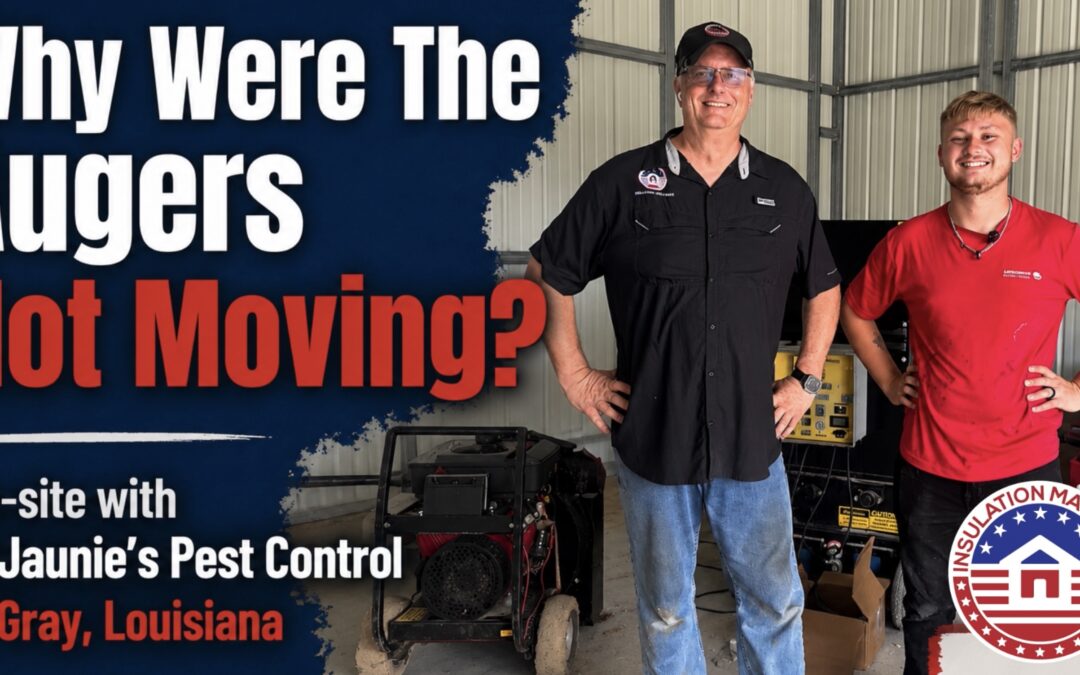
Recently, while traveling through the beautiful Mississippi Delta region of Gray, Louisiana, we visited LaJaunie’s Pest Control to help diagnose a performance issue with their CM1500HP. What started as a service call quickly became a great example of why understanding your insulation equipment is so important.
As contractors ourselves, we always tell customers that when something doesn’t seem right, the first step is often the simplest:
Open the machine and look.
Unlike many pieces of equipment that require extensive diagnostics or specialized service centers, the CM1500HP was designed so contractors can quickly identify and correct many common issues themselves.
In this case, that design philosophy paid off.
A Surprising Discovery Inside the Hopper
When we opened the machine, we discovered an unusually large amount of wet cellulose insulation inside the hopper. Some of the material had become so compacted that it was almost concrete-like in consistency.
Initially, this was confusing.
LaJaunie’s Pest Control does not perform wall spray applications, which is often where contractors encounter excessive moisture in cellulose insulation. Since wall spray wasn’t part of their operation, we knew we needed to keep investigating.
The answer turned out to be something many contractors overlook: humidity.
The Impact of Humidity on Cellulose Insulation
Gray, Louisiana sits in a region known for its high humidity levels throughout much of the year. Over time, cellulose insulation left inside a machine can absorb moisture from the surrounding air.
Many contractors assume this is only a concern for wall spray applications, but that’s simply not the case.
Even dry cellulose insulation can absorb enough moisture in humid climates to create problems if it remains in the hopper for extended periods.
The CM1500HP can process wet material remarkably well. In fact, it handled far more moisture than many insulation blowers would tolerate. However, there comes a point where moisture accumulation becomes excessive.
When cellulose remains inside the hopper, especially in humid environments, it can harden and compact. Given enough time, it can become almost cement-like.
That’s why one of the most important maintenance practices we recommend is emptying the machine after every use.
This simple habit helps prevent material buildup, reduces wear on components, and keeps the machine operating efficiently.
Whether you’re performing attic insulation, retrofit insulation, dense pack applications, drill and fill projects, or general insulation work, removing leftover cellulose from the machine should become part of your standard shutdown procedure.
A Second Issue: Fiberglass Rake Fingers
During our inspection, we also discovered rake fingers installed in the machine.
The rake fingers had been used during previous fiberglass insulation applications. While they can be helpful when processing certain fiberglass products, they were no longer beneficial after the company transitioned to cellulose insulation.
As part of the troubleshooting process, we removed the rake fingers and reviewed how different materials interact with the machine’s agitation system.
This is another reason why understanding your equipment matters. Small setup changes that worked well for one material may not be ideal when production methods change.
The Importance of a Dedicated Maintenance Person
One of the most valuable parts of our visit had nothing to do with the machine itself.
We spent time working alongside Jobie Jernigan, who will be taking a larger role in maintaining the company’s equipment moving forward.
We would like to thank Jobie for his hard work, positive attitude, and willingness to learn.
Every insulation contractor, wildlife removal company, pest control company, and attic restoration business should have at least one crew member who understands machine maintenance and troubleshooting.
Having a dedicated maintenance person offers several benefits:
• Reduced downtime
• Faster problem diagnosis
• Lower repair costs
• Improved production
• Longer equipment life
• Greater confidence in the field
Many service calls can be avoided when someone on the crew understands how the machine operates and knows what to inspect when performance changes.
Routine Maintenance Performed During the Visit
While onsite, we also completed several maintenance tasks and training exercises.
These included:
• Replacing airlock seals
• Reviewing preventative maintenance procedures
• Inspecting machine components
• Discussing material flow characteristics
• Demonstrating troubleshooting techniques
• Training on routine service procedures
The goal wasn’t simply to fix a problem. The goal was to help the team understand why the problem occurred and how to prevent it in the future.
Built for Contractors
The CM1500HP by Cool Machines has earned a strong reputation among insulation contractors because it combines portability, productivity, and simplicity.
Many insulation blowers become intimidating when something goes wrong. The CM1500HP takes a different approach.
The machine was designed so contractors can open it up, inspect components, understand how material moves through the system, and perform many maintenance procedures themselves.
That simplicity translates directly into less downtime and more productivity.
Final Thoughts
Our visit to LaJaunie’s Pest Control reinforced a lesson we teach regularly:
The best maintenance program starts with understanding your machine.
Humidity, material buildup, worn components, and configuration changes can all affect performance. The good news is that many issues can be identified and corrected quickly when operators know what to look for.
If you’re operating in a humid climate, remember to empty your cellulose insulation blower after each use. Even if you’re not performing wall spray applications, moisture can accumulate and eventually cause material to harden inside the hopper.
And just as importantly, make sure someone on your team is responsible for machine maintenance and troubleshooting.
A knowledgeable crew member can save your company significant time, money, and frustration.
The CM1500HP insulation blower, replacement parts, accessories, and technical support by Cool Machines are available through Insulation Machines. Our team provides hands-on training, phone support, FaceTime troubleshooting, and onsite assistance to help contractors get the most from their equipment.
Frequently Asked Questions: Troubleshooting the CM1500HP
1. Why did the machine keep tripping breakers during the Gray, Louisiana onsite teardown?
During our jobsite visit, we discovered the crew was plugging both of the CM1500HP’s power cords into the same electrical circuit via a dual-outlet extension box. The CM1500HP is a split-system machine engineered specifically to distribute its high electrical load across two independent power cords.
-
Cord 1 powers the motor and primary drive systems.
-
Cord 2 powers the high-pressure auxiliary blowers.
To fix this issue instantly, always plug the cords into separate breaker circuits (e.g., one into a garage outlet and the other into a dedicated kitchen appliance circuit).
2. How do I check the health of my blowers?
The CM1500HP has male plugs in the base of the machine. Drop cords from the control panel are plugged into those. Unplug the two lower cords. Using an extension cord, plug directly into each blower, one at a time. This will power only the blower. Listen for a difference between the two blowers. If one sounds weaker, it is going bad.
3. What makes the CM1500HP easier to troubleshoot in the field compared to other commercial blowers?
The CM1500HP features an “open-architecture” modular design. Unlike traditional enclosed box units where you have to dismantle the entire outer frame to reach a single part, the CM1500HP features external diagnostic panels, a quick-release removable hopper assembly, and bolt-on mechanical components. A single technician can access, diagnose, and swap out the airlock seals, chains, or blowers right in the bed of a truck using standard hand tools.
4. What causes air to blow back up into the hopper instead of down the hose line?
This is a classic symptom of worn-out or damaged airlock seals. The airlock relies on a tight, pressurized chamber to force insulation down into the hose stream. If highly abrasive fiberglass or mineral wool has worn down the seals—or if a hidden piece of construction debris has torn them—the high pressure () from the blowers will escape backward along the path of least resistance up into the hopper. This stops all material feeding and requires an immediate seal replacement.
5. Why is the machine cranking and humming, but the shredder augers refuse to turn?
If the electrical system checks out but the shafts are locked up, check the contents of the hopper. You may need to remove the hopper to see if the insulation material or other junk has accumulated around the augers. If you leave insulation in a hopper, in a humid climate, for a long time, that material may become concrete-like.


