

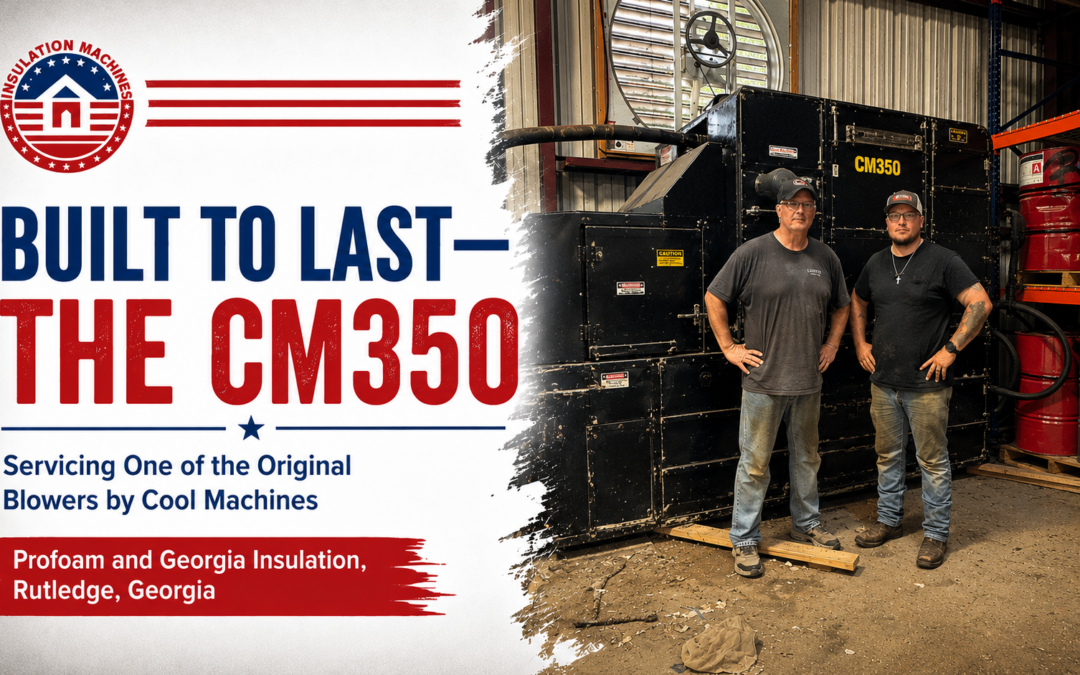
When people ask us why we have so much confidence in equipment by Cool Machines, stories like this are the answer.
Recently, we traveled to Rutledge, Georgia, to work with Profoam and Georgia Insulation on one of the original CM350 insulation blowers by Cool Machines. Built in 2010, this machine is still operational and is now being prepared to go back into regular service.
In an industry where equipment is expected to work in demanding conditions day after day, having a machine still running after more than 15 years says a great deal about the quality of its design and construction.
Built During the Early Years of Cool Machines
The CM350 represents an important chapter in the history of Cool Machines. It was one of the company’s earliest insulation blowers and was engineered to handle multiple applications while emphasizing productivity.
Unlike today’s models, the CM350 was constructed from aluminum. Aluminum offered two major advantages: it reduced overall weight while providing excellent corrosion resistance. As material costs increased over the years, Cool Machines transitioned to powder-coated steel construction on newer models. The powder-coated finish provides outstanding durability while making the machines more economical to manufacture.
Both approaches were designed with longevity in mind, and machines like this CM350 demonstrate just how well that philosophy has worked.
Designed for Wall Spray Recycling
One of the unique features of the CM350 is its integrated VacPack system.
The machine was designed to internally recycle wall spray material. During wall spray applications, excess material can be collected and returned directly to the machine, allowing it to be processed and reused rather than discarded.
The CM350 accomplishes this with a large recycler dedicated to wet material while maintaining a separate hopper for dry insulation.
Although it excelled at wall spray recycling, the machine was also built to handle dense pack applications as well as attic fill, making it a versatile insulation blower for contractors working in multiple areas of the industry.
Big Machine, Big Capacity
There is no denying that the CM350 is a substantial machine.
Its size typically requires mounting on a truck, and its large recycler and hopper allow contractors to process significant amounts of material. At the time it was introduced, this design gave contractors tremendous production capability.
As equipment technology advanced, however, Cool Machines continued refining its insulation blowers.
Today’s machines deliver the same applications and production capabilities while occupying a much smaller footprint. Contractors gain more available truck space without sacrificing performance.
The newer machines also feature simplified electrical systems that make troubleshooting, maintenance, and repairs easier than on some of the earlier models.
That continuous improvement is one reason Cool Machines has earned such a loyal following throughout the insulation industry.
Maintenance Makes the Difference
During our visit, Cory Eaton, who oversees fleet maintenance and safety for Profoam and Georgia Insulation, worked alongside Barry to prepare the CM350 for service once again.
Having someone dedicated to fleet maintenance is a tremendous asset for any insulation contractor. Regular inspections, preventive maintenance, and timely repairs help extend equipment life while minimizing downtime on the job.
While the durability of the machine deserves recognition, its longevity is also a reflection of owners who understand the value of taking care of their equipment.
Proper maintenance allows quality equipment to continue performing year after year.
Built to Work
What impressed us most wasn’t simply that the CM350 still runs.
It was the fact that Profoam and Georgia Insulation plans to mount it on a truck and put it back to work.
Many older machines eventually become shop displays or backup units that rarely see a jobsite. This CM350 has a different future ahead of it. After servicing and preparation, it will once again be installing insulation for customers.
That’s exactly what quality equipment is supposed to do.
Looking Back—and Looking Ahead
Seeing one of the original CM350 insulation blowers still operating reminds us how far insulation equipment has come.
Today’s Cool Machines insulation blowers are more compact, easier to maintain, and designed with years of field experience behind them. Every generation has benefited from improvements in engineering, serviceability, and efficiency.
Yet it’s also rewarding to see where that evolution began.
This CM350 serves as a reminder that well-built equipment, combined with proper maintenance, can continue delivering value for many years.
We appreciate Profoam and Georgia Insulation for allowing us to be part of bringing this historic machine back into service, and we especially thank Cory Eaton for his commitment to keeping their fleet operating safely and efficiently.
Sometimes the best way to appreciate how far equipment has advanced is by seeing one of the originals still doing exactly what it was built to do.
Frequently Asked Questions (FAQ)
1. How long has this specific CM350 insulation blower been in service?
This legendary machine has been running consistently since 2010. It serves as living proof of the industrial-grade durability engineered into the earliest generations of Cool Machines equipment. While many standard entry-level machines give out after a few years of heavy daily use, this robust workhorse has crossed well over a decade of continuous service on commercial and residential jobsites.
2. Who owns and operates this original CM350 unit?
This particular unit is owned and operated by the professional teams at Profoam and Georgia Insulation, located out of Rutledge, Georgia. They have relied on the heavy-duty machine to anchor their loose-fill operations and maintain high production yields across their regional service area.
3. What kind of material can the CM350 insulation blower handle?
The CM350 is an industrial all-fiber machine. It is engineered to seamlessly process loose-fill cellulose, blown fiberglass, and mineral wool (rockwool). Its interior conditioning components break down tightly compressed manufacture bundles smoothly, fluffing the material to its optimal coverage density before feeding it down the line.
4. What component required servicing after years of field operation?
Despite its extreme longevity, high-volume pneumatic blowing eventually wears down sacrificial friction parts. The team recently brought the machine in to service its airlock seals and chain drives. Over time, abrasive insulation fibers (especially fiberglass) erode rubber seals, causing pressure to blow back into the hopper. Swapping these modular parts instantly restores the machine’s original factory pressure () and material flow rates.
5. Why do older Cool Machines models like the CM350 continue to run for decades?
Cool Machines engineers their fleet with an “open-architecture” modular concept using heavy steel and non-proprietary mechanical components. Instead of locking parts away in enclosed, unserviceable boxes, key elements like the blowers, chains, sprockets, and seals are fully accessible. This allows contractors to perform routine maintenance or field-swaps rapidly, preventing catastrophic wear and keeping the machine operational indefinitely.


