


In April, we traveled to Tulsa, Oklahoma to meet a long-term customer of ours — Affordable Insulation of Oklahoma. With a new crew, they asked us to stop in and work with them on dense pack cellulose.
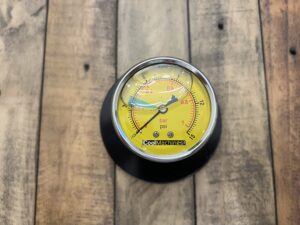
- Cool Machine’s dense pack gauge has an easy to read gauge with a green field noting the proper range of PSI for dense packing.
We spent the day with them, insulating the exterior walls of a garage that is conditioned air space. With a Krendl 2300, we showed the crew how to set the proper PSI. Since this machine does not come with a gauge, we used a hand-held gauge to measure the pressure. We do offer these gauges and they are a must if your machine does not have an internal gauge.
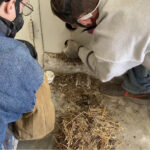
The homeowner recently purchased the home and added new siding to the house. The previous owner allowed birds to nest in the soffit areas. In one section of the wall, we found 10 dead birds and a nest that filled 6 feet of two wall cavities. We spent time removing the nest debris as well as the carcasses.
Dense packing these walls also presented another problem. The compromised siding allowed rain into the wall and cause the drywall to become brittle when it dried out. We were still able to get sufficient fill in the wall without blowing the wall out. We dialed the PSI back to 2.5 and the wall will still be well insulated.
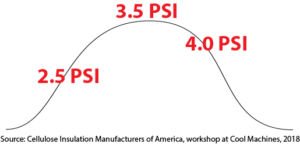
- This bell curve shows the proper PSI density for installing cellulose.
A word about PSI and dense packing. The recommended pressure to dense pack cellulose is determined, ultimately, by the manufacturer of the insulation. The most optimal pressure is 3.5 PSI. That is optimal, but not the only pressure you can install. Cellulose will be dense packed correctly with pressures between 2.5 and 4.0 PSI. That range of pressure will give you the ability to pack in the cellulose without breaking out walls. If 2.5 is breaking out a wall… then we would recommend the homeowner improve the wall by replacing or covering over with more drywall.
-
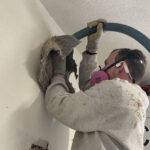
- Sometimes you have to pack from the top! Above doors, windows and electrical components.
-
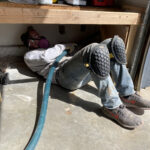
- Mostly, we work from the bottom.
-
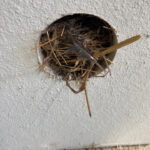
- Drilling a hole, we found a nest.
-
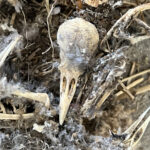
- 9 adult bird skeletons were pulled out of the wall.
-
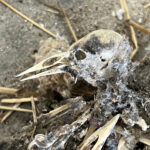
- We are not sure what kind of bird this is.
-
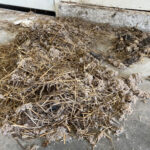
- A large mess of nest and skeletons. Up in the wall cavity about 6 feet.
-
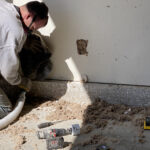
- Packing a wall from the bottom. Keeps the repairs less visible and makes sure the cavity is filled from top to bottom.


